


Call or text (315) 380-1005 Rev. Heath Can Help!
For your convenience and accessibility, all counseling is provided via
Tele-therapy.
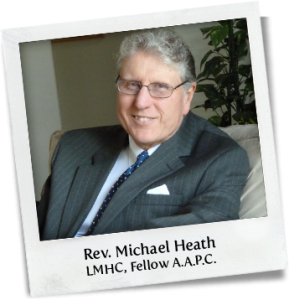
Welcome, I’m Michael Heath and this is the Pine Ridge Pastoral Counseling Web Page. Pine Ridge is a place for folks who are looking for the best mental health care but who are turned off by large clinics or impersonal facilities. Since 1994, Pine Ridge has offered a distinctive, more personal, and holistic alternative to mental health services, providing help to individuals and couples with a wide range of emotional, relational, life-phase, and spiritual problems.
I specialize in helping individuals who experience problems with anxiety, stress, shame, low self-esteem, and pornography. I help teach couples how to improve their communication while helping them with problems such as anger, sex, affairs and divorce. I also counsel folks dealing with grief/loss and life transitions such as retirement and aging.
My approach is not to judge or condemn, but to understand. By identifying past emotional wounds, I’m able to get to the underlying source of their present difficulties, expose the trauma-related distortions, and promote healing and personal growth.
It’s important to know that some emotional problems aren’t simply psychological. Since I am both a New York state-licensed mental Health counselor and a nationally certified pastoral counselor, I offer a comprehensive therapeutic approach that addresses, when indicated, both the psychological and existential/spiritual dimensions of life’s difficulties.
This website is a great place to learn about my areas of expertise and expertise as well as finding answers to questions you may have about individual or couples counseling.
Helping People Throughout New York State.

Latest Blog Articles
By Rev. Michael Heath

A.I., Counseling & You
Artificial Intelligence and Health Care
AI also plays an important role in our health. We use AI to look up suspicious medical symptoms and medication information. Its ratings help us to choose which doctors we see.
Its applications for health bring us to how folks use AI for emotional and psychological problems. While the impact of AI on counseling and mental health is not fully known, here is a summary of what we know so far. Artificial Intelligence in the Behavioral Health Professions: Ethical and Risk Management Issues: Frederic G. Reamer: 9780871016270: Amazon.com: Books
In general, using Artificial Intelligence to gather information is beneficial. As long as you check its results with multiple sources, A.I. can be a huge time saver. However, problems arise when people rely on A.I. chatbots.
With that in mind, here are some pros and cons of using A.I. to help with mental health issues.
Commons Myths about Therapy Debunked.
Ironically, although counseling has changed over the years, common myths persist. These false impressions are not only inaccurate; they can also dissuade folks from seeking helpful treatment. Sadly, this delay prolongs unnecessary suffering and pain. Given that so many people report feeling increased levels of stress and anxiety, I want to call out these false impressions and correct them. So today, let's review the top five most common misunderstandings that many have about psychotherapy/counseling and set the record straight. 1) Myth: You have to be crazy to see a counselor. Probably the most harmful myth that keeps people from seeking therapy is the false idea that you have to be in a serious crisis to talk to a counselor. That kind of thinking makes as much sense as believing that you would only go to a doctor if you were having a heart attack. Of course people seek psychological...

Empathy-Based Sex Education: A Guide for Parents.
EMPATHY-BASED SEX EDUCATION: A guide for parents.
It’s time to talk about sex education again. Although talking about sex with kids has come a long way, things like internet porn and political attacks against real sex education present new challenges for parents and educators. An empathy-based approach offers a better way. “The Talk” Survey: A Sex Education Map | Future Method – SIECUS
Why traditional approaches fail.
They ignore the emotional aspects of Sex
Traditionally, sex ed programs focused mostly on biology and ignored the important emotional issues. Guilt/shame, self-esteem/ body image, relationships and abuse, as well as sexual diversity are things kids need information about.
They wait too long to talk about sex.
There is good news. More parents and schools are talking to their kids about sex than they used to. However, many wait too long to begin. Many parents delay sexual conversations because of embarrassment, or they feel ill-equipped and confused about how to do it.
They forget that you don’t have to know it all. Looking things up together is a great bonding experience that conveys acceptance, interest and a willingness to work together.
An empathy-based approach that focuses on understanding what the child is feeling is less onerous for parents and can actually improve overall communication with their children.
They project their own negative sexual hang-ups.
Another problem is that, because of parents’ own distress in talking about sex. Thus, when it is done, it often conveys disapproval and does not encourage open and free discussion. Common Mistakes Parents Make When Talking to Kids About Sex – Educate Empower Kid
Besides blocking needed communication, harsh attitudes about sex create guilt and shame in the minds of curious children, often leaving them with no one to talk to about it. SEX & SHAME | Pastoral Counseling Syracuse NY .
They falsely believe real education promotes sexual activity.
Traditional approaches often regard anything but “abstinence-only” programs as the enemy. This outlook falsely believes that knowledge encourages morality and sexual activity.
In fact, the opposite is true. Multiple studies show that the more sex education a person has, the longer they delay having sex. Sex Education Linked to Delay in First Sex | Guttmacher Institute
They provide false or incomplete information.
As a consequence of the negative bias, abstinence-only programs and many parents are not honest about what they say to their kids about sex. Particularly with the issue of masturbation, false guilt and shame are created by not acknowledging that self-pleasuring impulses are normal and healthy both mentally and physically.
They fail to empathize and provide needed guidance.
Perhaps the biggest problem with traditional approaches is that they completely miss the emotional confusion, conflict, and pain sex creates for their children. In fact, children need empathy and compassionate guidance, not rebuke. Instead of criticism, young people need understanding, reassurance, and help.
Apreciating Job’s Impatience: Righteous Anger in the Face of Evil
Job’s Impatience: A Guide to Expressing Anger Constructively
Traditionally, the biblical character Job goes with patience, as in the common phrase “having the patience of Job? Job | Pastoral Counseling Syracuse NY Many Christians praise Job as a model of enduring faith in the face of adversity. What Does the ‘Patience of Job’ Mean? Indeed, despite unimaginable loss and suffering, Job declared his loyalty to God and did not curse him.
While not as widely appreciated, Job’s impatience is of equal importance. Various theologians,Holy Anger: Jacob, Job, Jesus: Basset, Lytta: 9780802862372: Amazon.com: Books , Yale literary critics, The Vision of Tragedy: Richard Sewall: 9780300008951: Amazon.com: Books, and even the cartoonist Charles Schulz, point out that the story of Job is complex and not simply about blind faith. Further, they directly challenge the common cliché of Job’s patience. Peanuts’ character, Linus, went so far as to say, ” A person who speaks only of the patience of Job reveals that he knows very little of the book.” ‘Peanuts’: Suffering, baseball, and religion.
Today I want to demonstrate how Job’s righteous anger, rather than his servile patience, offers a useful model for both honest faith and constructively expressing frustration and outrage in the wake of tragedy.
The Keys to Successful Marriage
Declining Divorce Rates Research Reveals the Keys to Successful Marriage With all of the bad news flooding the media today, you may have missed an important and growing trend. Over the past few years, divorce rates for first-time marriages dropped from 50% to almost 40%. https://www.cdc.gov/nchs/fastats/marriage-divorce.htm The reason for the change is complex and not fully known. One cultural shift is the fact that people are marrying later than they used to. The average age for marriage is now 30 rather than 21. Another change is that they have a more realistic understanding of love and marriage than they used to. https://ifstudies.org/blog/divorce-in-decline-about-40-of-todays-marriages-will-end-in-divorce As information increases, more folks are letting go of the traditional yet grossly unrealistic ideas of romantic love (RL). Specifically, folks today have a better, more...
Romantic Myths: Out, Realistic Views In
With all of the bad news flooding the media today, you may have missed an important growing trend. Over the past few years, divorce rates for first-time marriages dropped from 50% to almost 40%. https://www.cdc.gov/nchs/fastats/marriage-divorce.htm
The reason for the change is not fully known. Couples marrying later, at 30 rather than at 21, may be one reason. Couples having a more realistic understanding of love and marriage is another important factor.
As information increases, more folks are letting go of the traditional yet grossly unrealistic ideas of romantic love (RL). Specifically, folks today have a better understanding of what love is and what is needed to make a marriage last
Today, I want to contrast RL with Dr. Sara Nasserzadeh’s Emergent Love Model (ELM). Dr. Nasserzadeh’s work provides a useful summary of a more realistic view of love and marriage. Rethinking Relationships: The Emergent Love Model | Psychology Today.
Rather than myths https://revmichaelheath.com/on-romantic-love/, Dr. Nasserzadeh’s model is based on rigorous research that reveals the qualities of good and lasting marriages. Beyond identifying the essential elements of marriage, this model also dispels the romantic myth concerning love.
This view posits that love is what people experience as a result of a six-factor cluster of loving behaviors. In other words, although an initial attraction may “just happen,” mature and sustainable love requires intentional effort and commitment.
With this in mind, let’s review the basics of romantic love and marriage (RL), and then the more realistic Emergent Love Model (ELM).

Journaling and Privacy
Recently, the Senate Homeland Security and Governmental Affairs Committee called Dr. Anthony Fauci to testify. https://www.nytimes.com/2026/07/29/us/politics/fauci-testifies-rand-paul.html The context for this hearing was partisan anger over how the Biden Administration handled the COVID-19 pandemic. Since Dr. Fauci served as the Chief Medical Advisor to the president, he recommended many of the controversial policies.
As part of the proceedings, details from Dr. Fauci’s diary were revealed. While I do not wish to comment on political issues, I do need to object to what I view as a serious moral and ethical violation by the committee in revealing private diary entries to the public. I am disturbed by the violation of Dr. Fauci’s privacy. The fact that this journal was written on a government server does not mitigate the offense. Further, I want to clarify any misunderstanding folks may have about journals and emphasize why keeping them private is essential.
Journaling: the basics.
To be clear, a diary or personal journal is a private written record of one’s experiences. It is an exercise in which a person reflects on and sorts through their deepest thoughts, feelings, and concerns freely and without fear of condemnation or judgment.
Obviously, diaries differ emotionally from other sorts of writing. Specifically, they provide a space to be psychologically vulnerable while exploring embarrassing or disturbing issues.
The Science Behind Journaling
While journaling is an ancient practice, https://www.historyofinformation.com/detail.php?id=5026 , the science behind it is a more recent development. https://www.urmc.rochester.edu/encyclopedia/content?ContentTypeID=1&ContentID=4552b . When thoughts and feelings are put into words, brain activity shifts from the right hemisphere, where distress is felt, to the left side, where the experience can be understood and analyzed. The impact of this shift is to lower stress levels by as much as 38%. https://childmind.org/blog/the-power-of-journaling
It is not surprising, given the research, that primary process journaling, as counselors like to call it, is a crucial part of the therapeutic process. In addition to psychotherapy, journaling is an important part of good mental health practices.
Porn Addiction Realilty
Today I want to talk about the difficult and complicated problem of internet pornography. The proliferation of internet-based porn staggers the imagination and creates many problems for both individuals and relationships.
As a therapist, I have noticed a significant uptick in the number of clients contacting me for what they refer to as a porn addiction. While the term porn addiction is widely used, both the American Psychological Association and the WHO (World Health Organization) do not recognize porn addiction as a stand-alone diagnosis or psychological disorder.
Technically, the current diagnostic term found in the International Classification of Diseases (ICD-11) for excessive and uncontrollable urges to masturbate to pornography is Compulsive Sexual Behavior Disorder (CSBD). If a person feels out of control with porn or if masturbating is interfering with important aspects of his life or relationship, talking to a counselor can help. Understanding the source of their obsession and learning better ways to cope will relieve distress and restore control.
Sex isn’t the Problem
The key to understanding compulsive porn use, like with any compulsive behavior, is to realize that the behavior itself is not the problem. The use of pornography is an inadequate attempt to cope with an underlying problem. Thus, effective treatment requires both identifying and addressing the root cause.
For example, a person who abuses alcohol often uses drinking as a way to numb or provide relief from the pain caused by something like anxiety or a loss that they feel overwhelmed by and don’t know how to resolve. Once they recognize the problem and are confident that they have the resources and plan to deal with it, the need for alcohol diminishes. The same is true for sexual compulsions.
The last time I wrote on this subject was seven years ago. A Reasonable Approach for Discussing Masturbation and Pornography: Part 1 | Pastoral Counseling Syracuse NY(revmichaelheath.com) Given that misunderstanding has not declined, I wish to review and debunk some of the most persistent myths about compulsive masturbation and pornography. Let me be clear, however, while debunking myths, I am not promoting pornography. My only concern is that folks know the facts.

Normal Sex: An Update
I want to talk about sex or, to be more precise, about what is normal sex? What do you think is normal ? I want to explore this topic because a lot of my clients worry that what they’re doing or not doing wasn’t normal.
For example, they are anxious about not having enough sex, orgasms, or even interest. Upon investigating, however, most are worried over nothing. BAD IDEAS ABOUT GOOD SEX | Pastoral Counseling Syracuse NY
So that we are all on the same page, let’s start with some definitions:
Defining Sex.
To begin, by sex is a broad range of activities involving physical intimacy, erotic stimulation, and contact with reproductive organs or erogenous zones and non- erogenous areas. People engage in it for pleasure, emotional bonding, and reproduction Sex – Wikipedia to which I would also add personal satisfaction.The female sexual response: a different model – PubMed The Evolution of our Knowledge of Sexual Response
Sex is more than physical activity; it also involves biological, emotional, and relational responses. As we shall see, research expanded our understanding of sex to include these other elements over the past few decades.
What is normal ?
For more recent and past Mental Health postings, visit our Blog archive.